Outstanding Onions
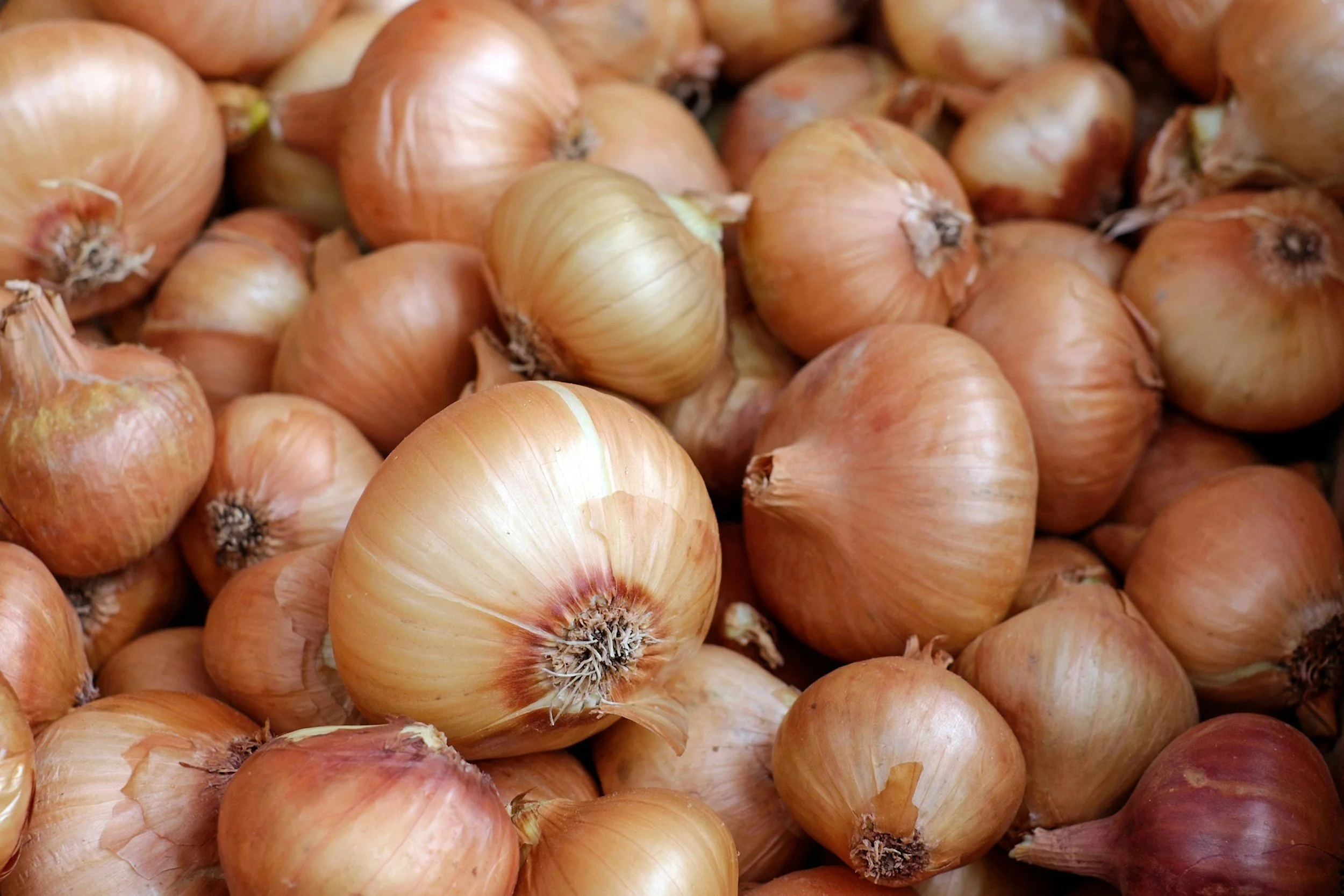
Summer is coming at a fast pace, and with it come some favorite vegetables like watermelon, cucumbers, and onions. What would a hot dog or hamburger be without a topping of chopped onions? While they might occasionally make you cry, their versatility makes them a favorite for many gardeners. June 22, 2026, is National Onion Ring Day, giving us yet another use for these versatile vegetables.
Onions (Allium cepa) are in the Amaryllidaceae family and are closely related to garlic, chives, shallots, and leeks. They take up little space, require little care, and can be repeatedly planted throughout the season if harvested as green onions (scallions) or allowed to grow into full bulbs (“dry onions”).
The common onion is native to central Asia, in what are now India, Afghanistan, Tajikistan, and Uzbekistan. Reportedly, they were domesticated because they were less perishable than many vegetables and could be easily transported. Their mention in the Bible (Numbers 11:5), discovery in the tomb of the Egyptian King Rameses IV (1160 B.C.), and use by the Greeks during the first Olympic Games reveal the long history of onions.
Onions were introduced to the Americas by the Spanish through the West Indies and spread from there. Besides using them as food, Native Americans used onions as poultices, syrups, and dyes. Early colonists brought them to the Americas both as a garden crop and as a cash crop. According to the USDA, in 2025 the United States grew nearly 7 billion pounds of onions on 125,000 acres of land. U.S. residents consume nearly 20 pounds of onions per person annually.
Onions are classified by color (red, yellow, or white) and by taste (pungent or sweet). They rely on photoperiod, or day length, to determine when bulbs begin to form. Short-day cultivars form bulbs early in the season, while long-day cultivars form later in the season. Intermediate-day (day-neutral) cultivars fall between early- and late-season cultivars. Long-day and intermediate-day cultivars are the best choices for Wisconsin gardeners because they produce more foliage early and develop larger bulbs.
When choosing a cultivar, keep in mind that any variety can be harvested as a green onion or allowed to mature into a dry onion. Onions can be planted by seed, sets, or transplants. Sets—small bulbs that develop rapidly—are the most common method for quick production. They are available in red, white, and yellow, though not usually by specific cultivar. Sets can be planted as soon as the ground can be worked, at a depth of 1–1.5 inches and close together, allowing some to be harvested as green onions while leaving others more widely spaced to mature into dry onions.
Seeds require more time and effort but can be purchased as specific cultivars. They can be started indoors 8–10 weeks before transplanting outside or planted directly in the garden. If directly sown, they will require a full growing season before harvest.
Transplants, sold in bundles of small bulbs with green leafy tops, are more time-consuming to grow than sets, but they offer a wider choice of cultivars. They can also be planted as soon as the ground is workable. Plant them at the same depth and spacing as sets.
While onions may not be as important as they were during the Middle Ages—when they were used to pay rent and given as wedding presents—they remain a valuable addition to any vegetable garden.
Carol Shirk
Certified Master Garden