Invasive Insects
Invasive species are those that are nonnative and adversely affect the habitat they invade, environmentally, economically, and ecologically. They impact plants, animals, and humans and require significant attention. A 2021 study cited by the USDA estimated that invasive species have cost North America $2 billion per year in the early 1960s to over $26 billion per year since 2010.
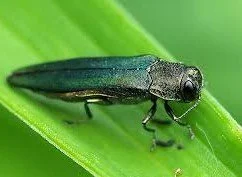
Insect invasive species have been in the news for a number of years. Emerald ash borer was confirmed in Wisconsin in 2008 after being confirmed in the United States since 2002. It likely was imported in shipping material from Asia. Since then, it has spread to all 72 Wisconsin counties and killed thousands of ash trees. Moving infested firewood is one of the primary means of spread, hence it is recommended that firewood be purchased and used locally.
For more information on emerald ash borer, including the potential to save an infected ash tree, go to the following site: https://eab.russell.wisc.edu/ If a new tree is being selected for the landscape, choose something that is not present in the neighborhood. Tree diversity will help prevent another devastating loss of one species if another invasive insect appears on the horizon.
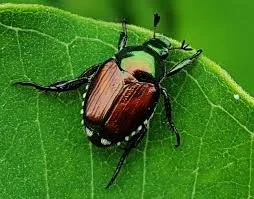
Japanese beetles are those metallic green insects that emerge around the first of July with a voracious appetite for what seems like everything in its path. They made their debut in the United State in 1916 and in Wisconsin in the 1990s. Although they have only one generation per season, the sheer number of them creates significant damage to agriculture and horticulture until early September. Although there is chemical control that is effective on this invasive species, it also kills beneficial insects. The heavily touted traps are not recommended. Although they do capture a large number of beetles, they attract larger numbers that escape and cause additional damage. More information is available at this site: https://hort.extension.wisc.edu/articles/japanese-beetle/
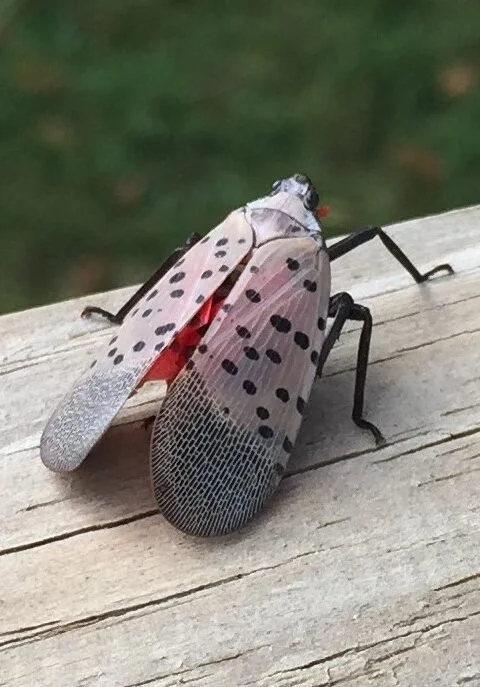
There are two species that have not yet been found in Wisconsin, but early detection is critical. Therefore, it is in the best interest of every citizen to become educated. Spotted Lanternfly is an invasive planthopper first detected in Pennsylvania in 2014 and now present in 15 states. It has spread as far west as Illinois and is well established in the Chicago area. It is a threat to grapes, tree fruits, hops, and landscape plants.
Spotted lanternfly adults are approximately 1 inch long and 1.5 inches wide; the wing span is 1.5 inches. The forewings are greyish with black spots at the base and have a grey, lace-like pattern towards the tips. The hindwings are bright red with black spots at the base, have white bands near the center, and have a black net-like pattern towards the tips. Generally, adults hold their wings over their bodies which obscures the hindwings. More information can be found at this site, including how to report if some are seen: https://hort.extension.wisc.edu/articles/spotted-lanternfly/
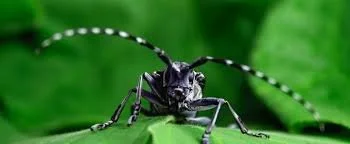
The second species not yet in Wisconsin, but to be on the lookout for is Asian Longhorn Beetle. This species entered the U.S. in 1996 and is already in Illinois. It is a threat to North American forests. They are dark with white spots and very long antennae. Some infestations have been eliminated by destroying the trees they were in. More information can be found at this site, including how to report if they are seen: https://datcp.wi.gov/Pages/Programs_Services/ALB.aspx
Carol Shirk
Certified Master Gardener