Cherries and Summer
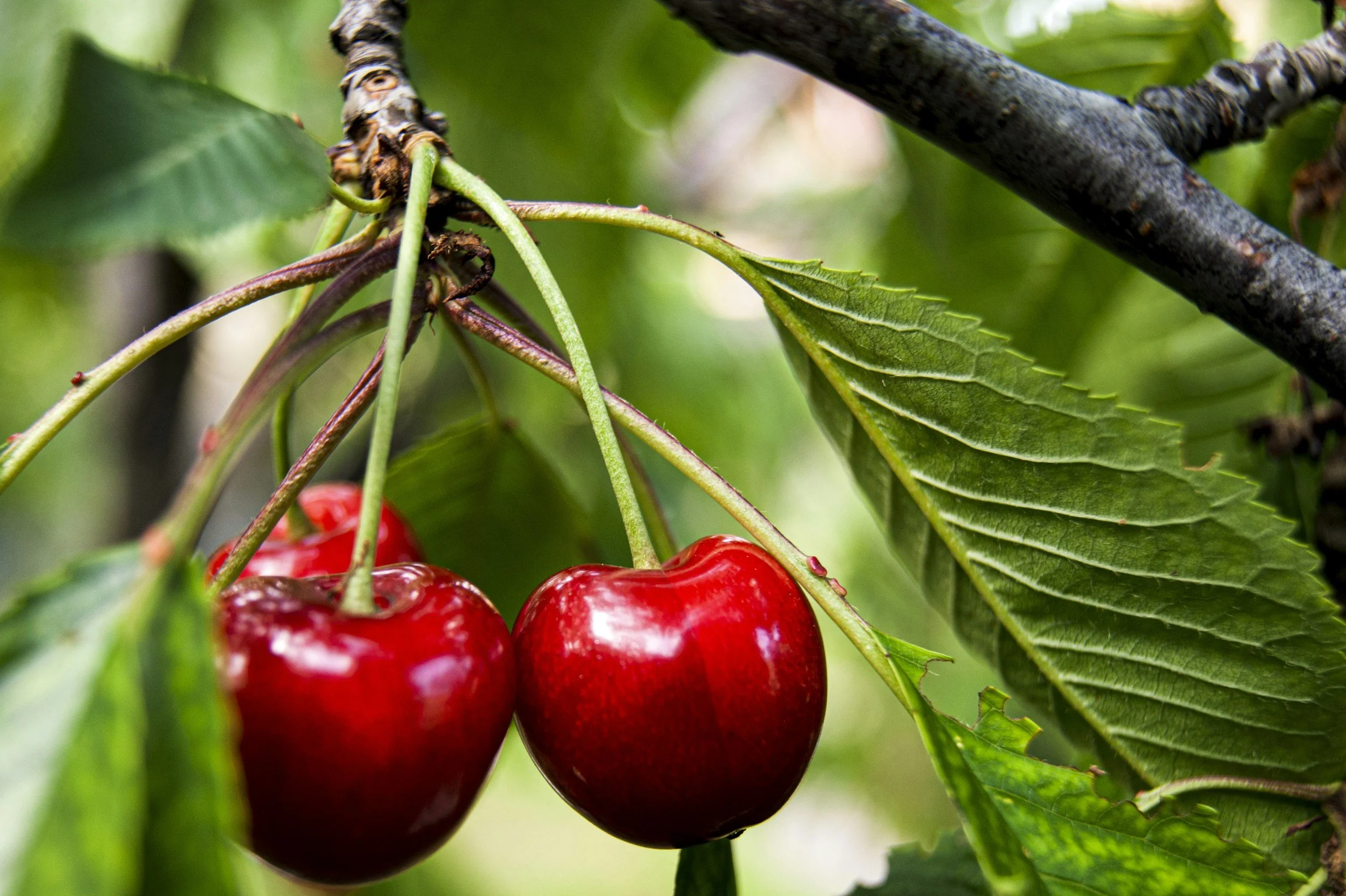
Cherries are a quintessential symbol of summer. Nothing beats a piece of cherry pie during a summer picnic. Having a cherry tree in the landscape not only provides a bounty of fruit, but the lovely pink blossoms in spring are also a sight to behold. If the harvest gets away from the grower for a season, the birds will appreciate the treat. When pruned properly, the tree itself is an attractive addition to the landscape.
Cherries are considered stone fruits (drupes), as are peaches, plums, nectarines, and apricots, due to the pits in their centers. All belong to the genus Prunus, which is native to Europe, western Asia, and North Africa. French and English colonists brought trees and seeds to the New World in the 1600s. The fruit spread quickly across the continent. Today, Washington leads the country in sweet cherry production, while Michigan leads in tart cherry production.
Cherries are divided into two categories: tart and sweet. Tart cherries (Prunus cerasus), also known as acid, sour, or pie cherries, are commonly used in baked goods, sauces, and jams. Sweet cherries (Prunus avium) can be eaten fresh or cooked. Tart cherries are self-fruiting while most sweet cherries require a second compatible sweet cherry tree for pollination. Some newer sweet cherry cultivars are self-pollinating. Both tart and sweet cherries generally produce larger harvests when a second compatible cultivar is planted nearby. However, sweet and tart cherry trees cannot serve as pollinizers for one another.
Of the two types, tart cherries are the most adapted to northern climates. The trees are smaller and vase-shaped, making them ideal for smaller landscape spaces. Choose a location that receives full sun, has good drainage, and is protected from high winds. Be sure to allow enough room for the mature tree. Most tart cherry trees reach about 15 feet in height with a similar spread, although some dwarf varieties are roughly half that size. Once planted, a tree cannot be easily moved, so planning a season ahead of planting is wise. Conduct a soil test and amend the soil as needed. Remove turfgrass and control perennial weeds to give the tree the best chance of success.
Choosing the right cultivar is very important to the success of a cherry crop. While Montmorency is the most well-known tart cherry in North America, several newer cultivars have demonstrated excellent production through extensive research. Balaton originated in Hungary and is sweeter than most tart cherries. Evans (also marketed as Bali or Evans Bali) is a Canadian introduction that performs well in northern climates. Surefire was developed at the New York State Agricultural Experiment Station. It blooms later and is more tolerant of frost, helping it to avoid the late spring freezes that can decimate a cherry crop. North Star is the only morello-type cherry on this list. It has mahogany-red skin rather than bright red skin and therefore produces dark juice. It is also exceptionally winter hardy. All of these cultivars are self-fruiting with fruit ripening in mid- to late July.
July 16 is National Cherry Day—the perfect time to consider adding a cherry tree to the landscape. I cannot tell a lie: it would be an ideal addition, offering benefits not only from a fruit-production standpoint but also from a landscape beautification standpoint.
Carol Shirk
Certified Master Gardener